
Health Library
Triquetrum Fracture: Symptoms, Causes, and Recovery
February 19, 2026
Question on this topic? Get an instant answer from August.
The triquetrum is a small, pyramid shaped bone on pinky side of your wrist. It is one of eight carpal bones that form wrist joint. Despite its size, it plays a key role in how your wrist moves and stays stable.
Where Is Triquetrum?
The triquetrum sits in proximal row of carpal bones, row closer to your forearm. It is third bone from thumb side, positioned between lunate and small pisiform bone.
You can feel it on back of your wrist, just below bony bump of ulna. To find it, hand is tilted toward thumb side so the triquetrum slides out from under ulnar styloid.
It connects with three neighboring bones. It meets lunate on its outer side, hamate below, and pisiform in front. It also touches triangular fibrocartilage complex (TFCC), a cushion of cartilage between wrist bones and ulna.
What Does Triquetrum Do?
The triquetrum helps your wrist bend, extend, and move side to side. When you tilt your hand toward pinky side (called ulnar deviation), it plays a particularly active role. It also stabilizes midcarpal joint between two rows of carpal bones.
The ulnar collateral ligament attaches to triquetrum, providing support on inner side of your wrist.
How Do Triquetrum Fractures Happen?
Triquetrum fractures are second most common carpal bone fracture after scaphoid, accounting for about 15 to 18 percent of all carpal fractures. They happen more often than most people expect.
The most common cause is falling onto an outstretched hand with wrist extended and tilted toward pinky side. Sports injuries, car accidents, and direct wrist impacts can also cause these fractures.
There are three main types of triquetrum fractures.
Dorsal chip fractures are by far most common, making up about 93 to 95 percent of cases. A small piece of bone pulled off back surface, usually by a ligament under tension.
Body fractures involve a crack through main part of bone. These are less common but more serious because they can disrupt wrist mechanics.
Volar fractures affect front surface and are least common. These may occur alongside ligament injuries.
If you have had a fall and your wrist hurts near pinky side, get it checked. Other carpal bones like trapezium can also fracture in similar falls. This guide on trapezium fracture symptoms may help you compare.
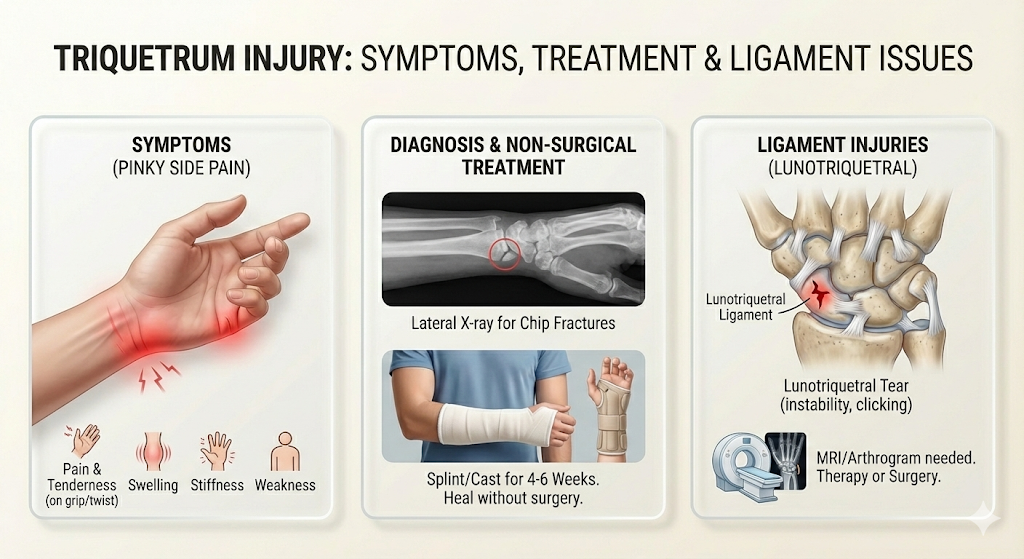
What Are Symptoms of a Triquetrum Injury?
The symptoms can feel like a bad sprain, which is why these fractures sometimes get missed.
You might notice pain on pinky side of wrist, especially when gripping or twisting. There is usually tenderness when pressing on back of wrist just below ulna. Swelling, stiffness, and a feeling of weakness are common.
Dorsal chip fractures often do not show up on a standard front to back x-ray. They are more visible on a lateral (side view) x-ray. If your doctor suspects a fracture but first x-ray looks normal, they may order additional views or a CT scan.
How a Triquetrum Fracture Treated?
Most triquetrum fractures heal well without surgery.
For dorsal chip fractures, the standard approach a wrist splint or short arm cast for four to six weeks. Pain usually improves within first two weeks.
Body fractures may need longer immobilization, and surgery might be considered if fracture is displaced. After cast comes off, physical therapy helps restore range of motion. Most people return to normal activity within two to three months.
What About Ligament Injuries Around Triquetrum?
The triquetrum is connected to several important ligaments, so a fracture does not always happen alone.
The lunotriquetral ligament connects triquetrum to lunate. If this ligament tears, the two bones can shift apart, causing lunotriquetral instability. This leads to clicking, weakness, and pain during wrist motion.
These injuries may not show on regular x-rays. An MRI or wrist arthrogram is often needed. Mild sprains may respond to splinting and therapy, while complete tears sometimes require surgical repair.
Are There Rare Conditions Involving Triquetrum?
Lunotriquetral coalition is a condition where lunate and triquetrum are partially or fully fused from birth. According to NCBI StatPearls review on carpal bone anatomy, this one of most common carpal coalitions. Many people never know they have it because it often causes no symptoms.
Avascular necrosis, where bone loses blood supply, is rare in triquetrum. The dorsal surface has richest blood supply, which likely protects it even after fractures.
An accessory bone called os triquetrum secundarium can appear near triquetrum on imaging. It looks like a tiny extra bone and can be mistaken for a fracture. Radiologists can usually tell difference by its smooth edges.
When Should You See a Doctor?
If you fell on your wrist and have persistent pain on pinky side, do not assume it just a sprain. Carpal bone fractures are easy to miss, and delaying treatment can lead to longer recovery.
See your doctor if pain lasts more than a few days, gripping becomes difficult, or wrist feels unstable. If you are dealing with a broader hand injury, this overview of broken hand symptoms may be useful.
Bottom Line
The triquetrum is a small but important wrist bone that helps you grip, twist, and move your hand. Fractures are more common than many realize and usually heal well with splinting and rest. If your wrist hurts after a fall, especially on pinky side, getting right imaging early makes a real difference.
Health Companion
trusted by
6Mpeople
Get clear medical guidance
on symptoms, medications, and lab reports.