
Health Library
Does Nexplanon Cause Weight Gain? What Evidence Shows
February 23, 2026
Question on this topic? Get an instant answer from August.
If you are using Nexplanon or thinking about getting it, weight gain is probably one of your top concerns. Its one of most commonly asked questions about implant, and you deserve a clear answer.
Here what research actually shows. Some people do gain weight while using Nexplanon, but it does not appear to cause significantly more weight gain than what most people would naturally experience over time. The picture is more nuanced than a simple yes or no.
What Do Clinical Studies Say About Nexplanon and Weight?
According to FDA-approved drug label, average weight gain among U.S. etonogestrel implant users in clinical studies was about 2.8 pounds after one year and 3.7 pounds after two years. The label also notes that it unclear how much of that weight change was actually caused by implant itself. You can review those details here: Nexplanon FDA Drug Label
To put those numbers in context, adult women tend to gain roughly 0.4 to 0.6 kilograms (about 1 to 1.3 pounds) per year on average, regardless of what type of contraception they use. So weight changes seen in Nexplanon studies overlap quite a bit with normal background weight gain.
A large study that tracked over 1,000 young women who received implant found that patients gained weight both before and after insertion at a similar rate. The implant did not speed up or worsen rate of weight gain compared to time before they had it placed.

So Why Do Some People Feel Like They Gained Weight on Nexplanon?
This is an important question, and there are a few possible explanations.
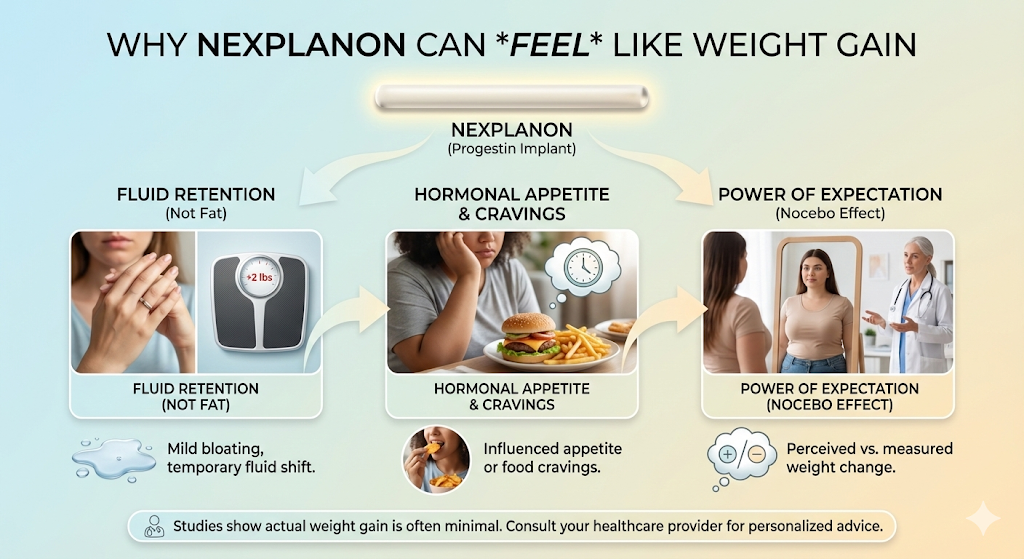
First, Nexplanon releases etonogestrel, a synthetic progestin. Progestins can cause mild fluid retention in some people. This is different from actual fat gain. It may show up as a few extra pounds on scale or slight bloating, especially in first few months.
Second, hormonal changes can sometimes influence appetite or cravings. This does not happen to everyone, but some people notice they feel hungrier or have stronger cravings for certain foods after starting Nexplanon. Over time, even small increases in calorie intake can add up.
Third, there is power of expectation. Research has shown that when patients are told a medication may cause weight gain, they are more likely to perceive weight gain, even when their measured weight has not changed significantly. In one study, women using a progestin implant were more likely to report feeling like they gained weight compared to a control group, even though their actual measured weight was not meaningfully different. This sometimes called nocebo effect.
Does Everyone Gain Weight on Nexplanon?
No. Weight changes with Nexplanon vary quite a bit from person to person. In a pooled analysis of clinical trials involving over 900 women who used implant for two or more years, here is how weight changes broke down:
- About 25% of women gained 0.1 to 2.5 kilograms (up to about 5.5 pounds)
- About 24% gained 2.6 to 5.0 kilograms (roughly 5.5 to 11 pounds)
- About 9% gained 5.1 to 7.5 kilograms (roughly 11 to 16.5 pounds)
- About 11% gained more than 7.5 kilograms (over 16.5 pounds)
But again, these numbers come from studies without a control group. That means we cannot separate how much weight was due to implant and how much was simply part of normal life changes over two to four years.
A study published through National Institutes of Health compared adolescent and young adult implant users with matched controls who were not using hormonal contraception. The weight gain in implant group was not statistically different from control group. The researchers concluded that etonogestrel implant appears to be an effective and weight-neutral option. You can read full details of that study here: Weight in Adolescent Implant Users
Are Some People More Likely to Gain Weight on Nexplanon?
There does seem to be a small subset of people who gain more weight than expected while using implant. In clinical studies, about 2.3% of users had implant removed specifically because of weight gain.
Some emerging research suggests that genetics may play a role. One study found that certain variations in estrogen receptor gene were linked to greater weight gain during implant use. This still early-stage research, but it may help explain why some people are more sensitive to hormonal changes than others.
If you already have concerns about how hormones affect your body, it can help to understand how different hormonal methods compare. This breaks down what to know about lower-hormone options: Low Estrogen Birth Control Options
How Does Nexplanon Compare to Other Hormonal Methods?
Weight gain is reported across nearly all forms of hormonal contraception, including pills, patches, rings, and IUDs. Nexplanon does not stand out as causing more weight gain than other methods.
In fact, one three year comparative trial found that 6.5% of etonogestrel implant users reported weight gain, compared to 7% of levonorgestrel implant users. These numbers are very close. Injectable contraceptives like Depo-Provera tend to show more consistent evidence of weight gain than implants do.
So if weight is your primary concern, implant generally considered one of more weight friendly hormonal options available.
What Can You Do If You Notice Weight Changes?
If you have noticed weight changes after getting Nexplanon, here are some practical steps:
- Track your weight over time. A few pounds of fluctuation in first month or two may be fluid retention, not fat gain. Give your body time to adjust.
- Pay attention to appetite changes. If you notice increased hunger or cravings, small adjustments to your eating habits can help you stay on track.
- Stay active. Regular physical activity can help manage both weight and mood changes that some people experience with hormonal contraception.
- Talk to your doctor. If you are gaining weight steadily and it is affecting your quality of life, your provider can help you evaluate whether implant right fit or if a different method might work better.
If you are curious about how other hormone-based treatments can affect your body, this article explores some of side effects people experience with hormone pellet therapy: Side Effects of Hormone Pellets
Bottom Line
Nexplanon can be associated with some weight gain, but current evidence suggests it modest and similar to what most people would gain naturally over same period. It does not appear to cause dramatic or sudden weight increases in majority of users. A small number of people may be more sensitive to weight changes, and that worth monitoring.
The most helpful thing you can do track your own experience, stay in communication with your healthcare provider, and make an informed decision that fits your body and your goals.
Health Companion
trusted by
6Mpeople
Get clear medical guidance
on symptoms, medications, and lab reports.