
Health Library
Mounjaro Savings Card: How to Pay as Little as $25
February 26, 2026
Question on this topic? Get an instant answer from August.
TL;DR:
• The Mounjaro savings card can bring your cost down to $25 for up to a 3-month supply if you have commercial insurance that covers medication.
• If your commercial insurance does not cover Mounjaro, card can still lower your cost to around $499 per month.
• Government insurance like Medicare, Medicaid, and TRICARE does not qualify for savings card.
If you just got prescribed Mounjaro and price tag made your stomach drop, you are not alone. A single month of Mounjaro without any discounts can cost over $1,000. That is a lot. The good news is that manufacturer offers a savings card that can cut your out-of-pocket cost down significantly, sometimes to as little as $25.
How Much Can You Save with Card?
What you pay depends on whether your commercial insurance covers Mounjaro or not. Here is how two scenarios break down.
If your commercial insurance covers Mounjaro, you may pay as little as $25 for a 1-month, 2 month, or 3 month prescription. One month is defined as 28 days and up to 4 pens. A 3-month supply covers 84 days and up to 12 pens. The maximum monthly savings cap is $150 for a 1 month fill, $300 for a 2 month fill, and $450 for a 3 month fill. The annual savings limit is $1,950 per calendar year. You can use card for up to 13 fills per year.
If your commercial insurance does not cover Mounjaro, you can still use card. In this case, you may pay as low as $499 per month. The monthly savings cap here is up to $647, with an annual limit of $8,411 per calendar year. You can still use card for up to 13 fills per year.
So what does this mean for you? If your insurance covers Mounjaro, savings card makes it genuinely affordable. If your insurance does not cover it, card still takes a meaningful chunk off retail price, but you will be paying closer to $499 per month instead of $25.
Who Qualifies for Mounjaro Savings Card?
To be eligible, you need to meet a few requirements. You must have commercial drug insurance. That includes private plans, employer sponsored plans, and marketplace plans. You also need a valid prescription for Mounjaro for an approved use, which currently means type 2 diabetes.
You must be at least 18 years old and a resident of United States or Puerto Rico.
Now here is part that catches a lot of people off guard. You do not qualify if you are covered by any government funded healthcare program. That includes Medicare, Medicare Part D, Medicare Advantage, Medicaid, VA benefits, TRICARE, CHAMPUS, or any state prescription drug assistance program. This rule applies even if you also have a commercial plan as secondary insurance.
If you are on Medicare and looking for help, Medicare Prescription Payment Plan (sometimes called M3P) may offer an option to spread your costs into fixed monthly payments over year. Federal law now limits Medicare Part D out of pocket costs to $2,100 for full year of 2026. That cap only applies to prescriptions your plan covers.
How Do You Get and Use Card?
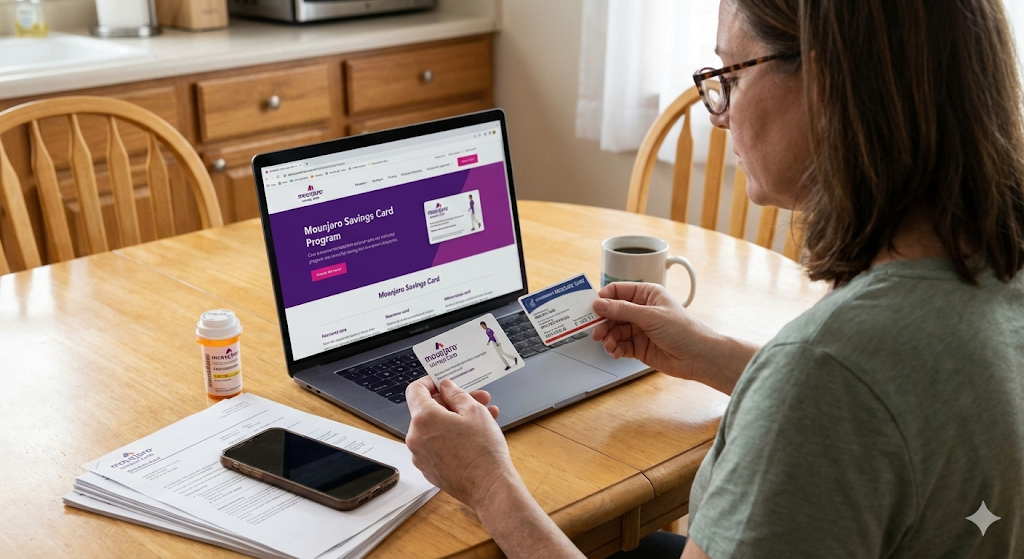
Getting card is straightforward. You visit official Mounjaro savings page on Eli Lilly's website. You check your eligibility and sign up. Once enrolled, you download or save card. The card includes a BIN number, PCN, and Group ID, which pharmacist needs to process it.
When you pick up your prescription, hand savings card to your pharmacist along with your regular insurance card. The pharmacy runs your insurance first, then applies savings card to reduce your remaining copay.
A few practical tips can help things go smoothly. First, ask your doctor to write a 3 month prescription if your insurance allows it. Paying $25 for three months of medication is a much better deal than $25 per month. Some pharmacies automatically fill a 1 month supply unless you specifically tell them prescription is for 3 months. If your pharmacy cannot do a 3 month fill, ask about transferring to one that can.
If card does not apply correctly at checkout, it is usually a processing issue, not a rejection. Ask pharmacist to double check BIN and Group ID codes.
What If You Do Not Qualify for Savings Card?
If you are on a government plan or do not have insurance at all, you still have options.
Eli Lilly runs a patient assistance program called Lilly Cares. It provides free medication to eligible people who are uninsured or underinsured and meet certain income requirements. You will need to submit income documentation and proof that other assistance was denied.
For people paying out of pocket, cash price for a 28 day supply of Mounjaro typically runs between $850 and $1,100 depending on pharmacy and your location. Third party discount cards from various platforms can sometimes bring this down to $780 to $950 range.
Can You Use Card for Weight Loss?
This is a common question. The savings card is only available for prescriptions written for an approved use. Right now, Mounjaro is approved for type 2 diabetes. It is not approved for weight loss on its own. If your doctor prescribed Mounjaro off label for weight management, savings card will likely not apply.
If weight management is your goal, ask your provider about Zepbound. It contains same active ingredient, tirzepatide, and is specifically approved for chronic weight management. Zepbound has its own separate savings card program with similar terms.
What Side Effects Should You Know About?
While managing cost is important, it helps to also be prepared for how medication might feel. The most common side effects of Mounjaro include nausea, diarrhea, decreased appetite, vomiting, constipation, and stomach discomfort. These are most common when starting or moving up to a higher dose.
Some people on GLP 1 medications also notice sulfur burps, which are more common than you might think. Others report muscle soreness or general body aches after starting treatment. If you experience these, it may help to read more about whether Mounjaro can cause body aches and what to do about it.
Most side effects ease up within a few weeks as your body adjusts. If anything feels severe or does not improve, talk to your doctor before continuing.
Conclusion
Mounjaro savings card is one of most effective ways to reduce what you pay for this medication. If you have commercial insurance that covers Mounjaro, you could pay as little as $25 for up to three months of treatment. If your insurance does not cover it, card still offers significant savings. The key is knowing your eligibility, understanding limits, and making sure your pharmacy processes everything correctly.
If you do not qualify for card, patient assistance programs and discount options can still help keep costs manageable. Talk to your provider or pharmacist to find path that works best for your situation.
Health Companion
trusted by
6Mpeople
Get clear medical guidance
on symptoms, medications, and lab reports.