
Health Library
Medical Transcriptionist: What the Job Is Really Like
January 12, 2026
Question on this topic? Get an instant answer from August.
What Does a Medical Transcriptionist Actually Do?
At its core, the job of a medical transcriptionist is to listen to audio recordings from physicians and other healthcare providers and transcribe them into written reports. But the reality of the role is far more nuanced than just typing. So, what does a medical transcriptionist do on a day-to-day basis?
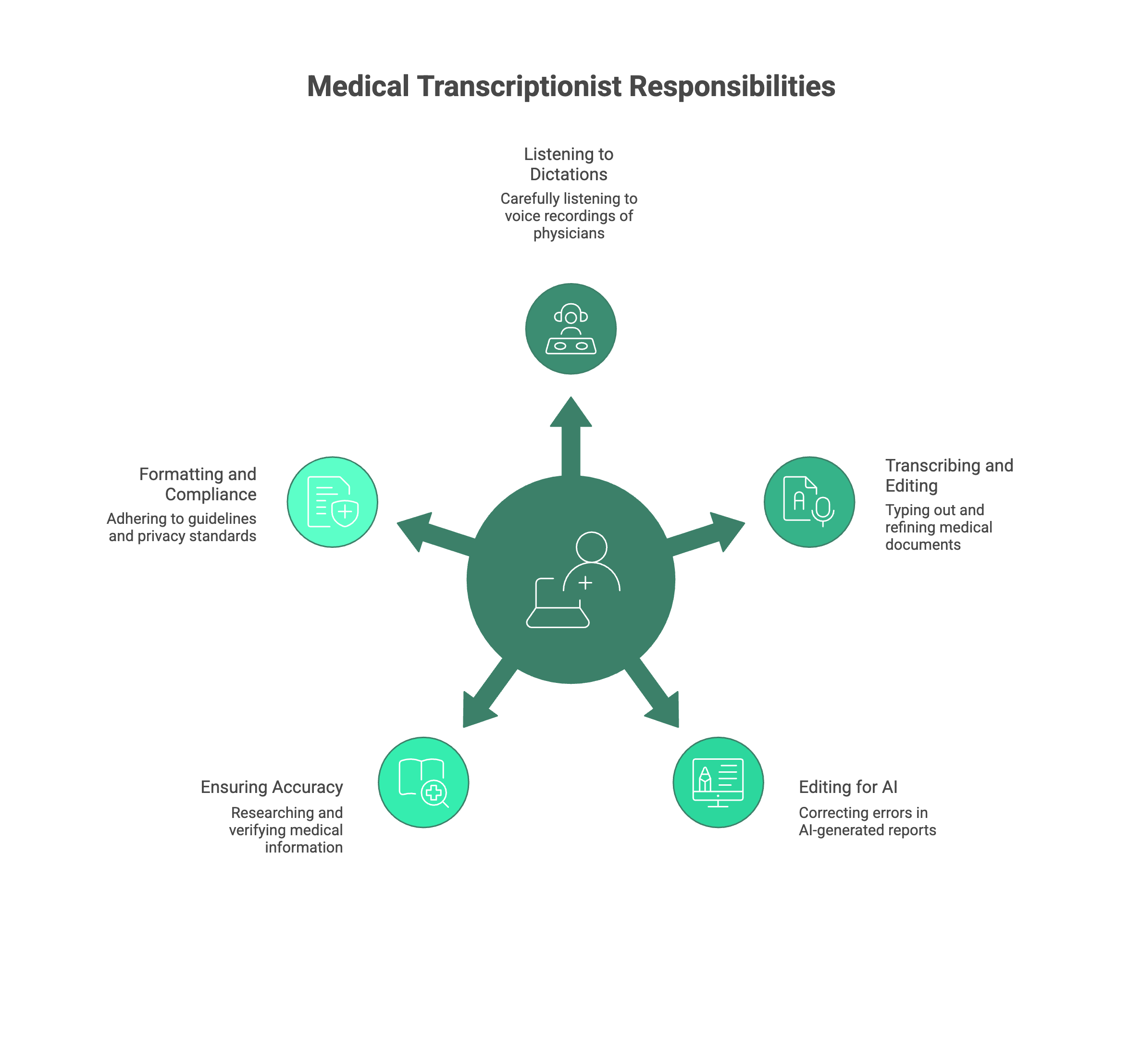
Their primary responsibilities include:
- Listening to Dictations: Using a headset and a foot pedal to control audio playback, they listen carefully to voice recordings of physicians dictating patient notes.
- Transcribing and Editing Reports: They accurately type out what they hear, creating a wide range of medical documents. These can include patient histories, exam notes, operative reports, discharge summaries, and referral letters.
- Editing for AI and Speech Recognition: A huge part of the modern role involves editing and proofreading documents generated by speech recognition software. While this technology is advanced, it’s not perfect. Transcriptionists use their expertise to catch errors in medical terminology, grammar, or context that software might miss.
- Ensuring Accuracy and Clarity: They research medical terms, drug names, and procedures to ensure everything is spelled correctly and makes sense within the context of the report. This requires a deep understanding of medical language.
- Formatting and Compliance: They format documents according to established guidelines and ensure that all reports comply with legal and privacy standards, most notably the Health Insurance Portability and Accountability Act (HIPAA). Upholding patient confidentiality is a non-negotiable part of the job.
They are the final quality check, the human element that ensures the story of a patient’s health is told with complete accuracy.
Medical Transcriptionist Salary and Job Outlook
When considering a new career, two of the most important questions are “What can I earn?” and “Is the job in demand?” Let’s break down the numbers for medical transcription.
Medical Transcriptionist Salary
According to the U.S. Bureau of Labor Statistics (BLS), the median annual wage for medical transcriptionists was $37,550 as of May 2023, which breaks down to about $18.05 per hour (source).
However, the medical transcriptionist salary can vary significantly. The BLS notes a wide range: * Lowest 10%: Earned less than $27,150 * Highest 10%: Earned more than $53,730
Factors that influence pay include your level of experience, your certifications, your geographic location, and your employer. For example, hospitals and specialized physicians’ offices often offer higher wages than general transcription service companies.
Job Outlook: The Full Story
The BLS projects a 5% decline in employment for medical transcriptionists from 2022 to 2032. At first glance, that might seem discouraging, but it’s crucial to understand the why behind the number.
The primary reason for this projection is the increasing sophistication of speech recognition technology. However, this doesn’t mean the profession is disappearing—it’s evolving. As mentioned earlier, the role is shifting from pure transcription to one of a healthcare documentation specialist or “medical editor.” These professionals are needed to provide the critical quality assurance that automated systems cannot. They review, edit, and perfect AI-generated text to ensure it’s 100% accurate for patient records.
Furthermore, the BLS also projects about 6,100 openings for medical transcriptionists each year, on average, over the decade. These openings are expected to result from the need to replace workers who transfer to different occupations or exit the labor force, such as to retire. So while the overall field is contracting slightly, consistent medical transcriptionist jobs will still be available for skilled and well-trained individuals.
How to Become a Medical Transcriptionist: A Step-by-Step Guide
Ready to take the first step? The path to becoming a medical transcriptionist is clear and accessible. Here is a breakdown of how to become a medical transcriptionist.
Step 1: Earn a High School Diploma or GED
This is the foundational requirement for any postsecondary training program and is the essential first step on your career path.
Step 2: Complete a Postsecondary Training Program
While it’s technically possible to enter the field without formal training, it’s extremely difficult and not recommended. Employers overwhelmingly prefer candidates who have completed a dedicated medical transcriptionist training program. You have two main options:
- Certificate Program: These typically take less than a year to complete and are offered by vocational schools and community colleges. They are highly focused on providing the core knowledge and skills needed for the job.
- Associate’s Degree: A 2-year program that provides a more comprehensive education, including general education courses alongside specialized transcription training. This can be beneficial for long-term career advancement.
A quality program will include coursework in: * Anatomy and Physiology * Medical Terminology * Pharmacology * Grammar and Punctuation * Healthcare Law and Ethics (including HIPAA) * Medical Record Formatting * Hands on Transcription Practice
Step 3: Gain Practical Experience
Most reputable training programs include a practicum or supervised on-the-job experience. This is where you’ll use transcription software, foot pedals, and headsets to transcribe real (anonymized) medical dictations. This hands-on practice is invaluable for building the speed and accuracy employers are looking for.
Step 4: Get Certified (Optional but Highly Recommended)
While medical transcriptionist certification is not legally required, it’s a powerful tool for demonstrating your competence and professionalism to potential employers. Many of the best medical transcriptionist jobs either prefer or require it.
The primary credentialing body is the Association for Healthcare Documentation Integrity (AHDI). They offer two key certifications:
- Registered Healthcare Documentation Specialist (RHDS): This is the ideal entry-level certification for recent graduates of a training program. Earning an RHDS certification proves you have the core knowledge and skills to succeed in the role.
- Certified Healthcare Documentation Specialist (CHDS): This certification is for experienced professionals who have already worked in the field and can demonstrate expertise across multiple medical specialties.
Earning your RHDS certification can significantly boost your resume and open more doors when you start your job search.
Essential Medical Transcriptionist Skills for Success
To excel in this field, you need a unique blend of technical abilities and personal attributes. Here are the core medical transcriptionist skills you’ll need to cultivate:
-
Hard Skills
- Fast and Accurate Typing: Speed is important, but accuracy is paramount. A high words-per-minute (WPM) count with minimal errors is essential.
- Excellent Grammar and Punctuation: You are the guardian of clear, professional medical documents.
- Deep Knowledge of Medical Terminology: You must be fluent in the language of medicine, from anatomy to pharmacology.
- Computer Proficiency: Comfort with word processing software, EHR (Electronic Health Record) systems, and transcription software is a must.
-
Soft Skills
- Exceptional Listening Skills: The ability to decipher different accents, dialects, and speaking paces is critical.
- Meticulous Attention to Detail: A single misplaced comma or misspelled drug name can have serious consequences.
- Critical Thinking and Research: You need to be able to recognize when something sounds incorrect and have the skills to look it up and verify it.
- Time Management: Especially for a work from home medical transcriptionist, managing your own schedule and meeting deadlines is key.
- Integrity and Discretion: You will be handling highly sensitive patient information, and maintaining confidentiality is an absolute requirement.
Work Environment: Where Do Medical Transcriptionists Work?
One of the biggest draws of this career is its flexibility. Medical transcriptionists work in a few primary settings:
- Hospitals: Many larger hospitals employ their own teams of transcriptionists to handle the high volume of daily documentation.
- Physicians’ Offices and Clinics: Private practices and specialty clinics often hire transcriptionists directly.
- Transcription Service Companies: These businesses contract with various healthcare facilities to provide documentation services. They are a major employer in the field.
The most significant trend, however, is remote work. A large and growing percentage of the workforce are work from home medical transcriptionist professionals. This allows for incredible flexibility, eliminates commute times, and provides a better work-life balance for many.
Medical Transcriptionist vs. Medical Scribe: What’s the Difference?
It’s easy to confuse these two roles, as both involve documenting patient encounters. However, the “how” and “where” are completely different. Understanding the medical transcriptionist vs medical scribe distinction is key.
-
Medical Transcriptionist:
- Location: Works remotely or in a back-office setting.
- Timing: Works after the patient encounter is over.
- Source: Transcribes pre-recorded audio dictations.
- Interaction: Has no direct interaction with patients or physicians during documentation.
-
Medical Scribe:
- Location: Works on site, in the exam room alongside the physician.
- Timing: Documents the patient encounter in real-time as it happens.
- Source: Listens directly to the conversation between the doctor and patient.
- Interaction: Works as a direct assistant to the physician during the patient visit.
In short, a transcriptionist documents the past, while a scribe documents the present.
conclusion
Becoming a medical transcriptionist is an excellent career choice for detail-oriented individuals who want to contribute to the healthcare field in a vital support role. It’s a profession that demands precision, a love of language, and a commitment to lifelong learning.
While the role is evolving with technology, the need for skilled human oversight to ensure the accuracy of patient records remains as critical as ever. With the right medical transcriptionist training and certification, you can build a stable and flexible career, often from the comfort of your own home.
If this guide has sparked your interest, the next step is to explore accredited training programs in your area or online. If you’re still exploring, consider looking into related healthcare support careers like medical coding or becoming a medical assistant to see what path best fits your skills and goals.
Health Companion
trusted by
6Mpeople
Get clear medical guidance
on symptoms, medications, and lab reports.