
Health Library
Adapalene vs Tretinoin: Which Retinoid Is Right for You?
February 21, 2026
Question on this topic? Get an instant answer from August.
Both adapalene and tretinoin are topical retinoids used to treat acne. They work by increasing skin cell turnover, preventing clogged pores, and reducing inflammation. The main difference comes down to tolerability and strength. Adapalene is gentler, more stable, available otc at 0.1%, and causes less irritation. Tretinoin is stronger, available only by prescription, and is used for both acne and anti aging concerns, but it tends to cause more dryness, peeling, and redness.
How Do They Work Differently?
Both adapalene and tretinoin belong to retinoid family, but they interact with your skin in slightly different ways.
Tretinoin (also known as all-trans retinoic acid) binds to multiple retinoic acid receptors in your skin cells. This broad receptor activity makes it very effective at speeding up cell turnover, unclogging pores, stimulating collagen production, and fading dark spots. However, it also means it can be quite irritating, especially in first few weeks.
Adapalene is a synthetic retinoid that selectively binds to specific retinoic acid receptors (mainly RAR beta and gamma). It does not bind to cytosolic retinoic acid binding proteins way tretinoin does. This selective binding gives adapalene strong comedolytic (pore unclogging) and anti inflammatory effects while causing significantly less irritation. Adapalene is also more chemically stable and less sensitive to sunlight and air than tretinoin, which breaks down when exposed to UV light or oxygen.
Which One Works Better for Acne?
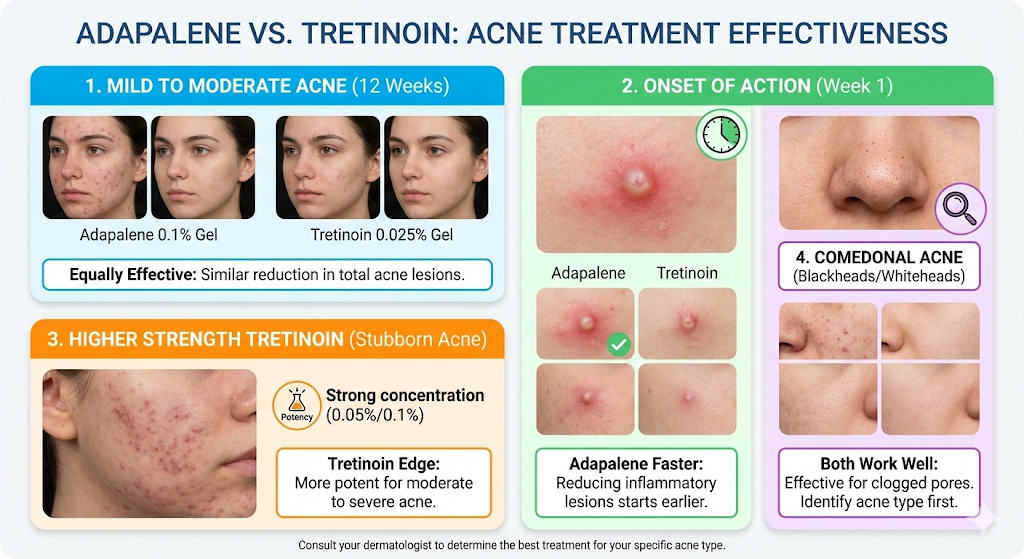
For mild to moderate acne, they are very similar in effectiveness. A comprehensive review published in PMC summarized multiple clinical trials comparing two. A meta-analysis of five large studies involving over 900 patients found that adapalene 0.1% gel and tretinoin 0.025% gel were equally effective at reducing total acne lesions after 12 weeks.
However, adapalene showed a faster onset of action. It began reducing inflammatory and total lesion counts as early as week one, while tretinoin took longer to show same level of improvement. Several individual trials confirmed that adapalene was either equally effective or slightly more effective at reducing non-inflammatory lesions (blackheads and whiteheads) compared to tretinoin 0.025%.
When you compare adapalene 0.1% to higher strength tretinoin (0.05% or 0.1%), tretinoin tends to have a slight edge in overall potency, particularly for stubborn or moderate to severe acne. Tretinoin 0.1% microsphere gel showed faster comedone reduction than adapalene 0.1% in one study, though adapalene still caused less irritation.
If your primary concern is comedonal acne (closed comedones, blackheads, clogged pores), both work well. If you are trying to tell whether your bumps are closed comedones or something else entirely, this comparison of closed comedones versus fungal acne can help you figure that out before starting treatment.
How Do They Compare for Irritation?
This is where adapalene clearly wins. Across nearly every clinical trial, adapalene caused significantly less redness, dryness, peeling, burning, and stinging than tretinoin.
In meta-analysis, adapalene had better tolerability scores at every evaluation point throughout 12 week studies. Fewer patients in adapalene groups discontinued treatment because of side effects compared to tretinoin groups.
Tretinoin is known for causing what many people call "retinoid purge" or "retinoid dermatitis" in first two to six weeks. During this period, your skin may peel, flake, feel tight, look red, and break out more before it starts to improve. This adjustment period is real and can be discouraging, but it usually settles down with continued use. If you are starting tretinoin and want to know what to expect, this guide on tretinoin side effects walks through timeline and how to manage it.
Adapalene still causes some degree of retinoid dermatitis, but it is typically milder and resolves faster. This makes adapalene a better starting point for people with sensitive skin, darker skin tones that are prone to post-inflammatory hyperpigmentation, or anyone who has never used a retinoid before.
Can You Use Them for Anti Aging?
This is where tretinoin has a clear advantage. Tretinoin is most studied topical retinoid for anti aging. It has decades of research supporting its ability to reduce fine lines and wrinkles, improve skin texture, increase collagen production, and fade sun damage and age spots. It is FDA approved for treatment of photoaging (marketed as Renova at 0.02% and 0.05% concentrations).
Adapalene has not been studied as extensively for anti aging. While it does increase cell turnover and has some effect on collagen, it does not have same depth of evidence for wrinkle reduction or photoaging treatment. If your primary goal is anti aging with acne as a secondary concern, tretinoin is stronger choice.
If your main goal is acne treatment and you are not focused on wrinkles, adapalene does job well with less irritation.
Which One Is Available Otc ?
Adapalene 0.1% gel (sold as Differin and store brand versions) is available without a prescription. This makes it most accessible retinoid for people who want to start treating acne at home. It is only topical retinoid currently approved for over counter use.
Tretinoin requires a prescription in all strengths (0.025%, 0.05%, 0.1%) and formulations (cream, gel, microsphere gel). Higher strength adapalene (0.3%) also requires a prescription.
How Should You Choose Between Them?
The right choice depends on your skin concerns, sensitivity, and goals.
Adapalene may be better fit if you have mild to moderate acne and want an effective first line treatment, your skin is sensitive or easily irritated, you have a darker skin tone and are concerned about post-inflammatory hyperpigmentation from irritation, you want something available without a prescription, or you have never used a retinoid before and want a gentler starting point.
Tretinoin may be better fit if you have moderate to severe acne that has not responded to adapalene, you are looking for combined acne treatment and anti aging benefits, you are treating photoaging (fine lines, sun spots, texture), or your doctor recommends a higher potency retinoid for your specific skin concerns.
In many cases, starting with adapalene and moving to tretinoin later if needed is a practical approach. This lets your skin build tolerance gradually.
Bottom Line
Adapalene and tretinoin are both effective retinoids for acne. Adapalene is gentler, works faster in early weeks, causes less irritation, and is available over counter. Tretinoin is more potent at higher strengths and has strong evidence for anti aging. For most people starting out with acne, adapalene is easier and more forgiving option. For those who need more strength or want anti aging benefits, tretinoin is gold standard. Either way, consistency, sun protection, and patience are key to getting results with any retinoid.
Health Companion
trusted by
6Mpeople
Get clear medical guidance
on symptoms, medications, and lab reports.